






Catholic media outlets frequently herald the vocations crisis, bewailing that young men and women are not becoming priests and religious sisters anymore.
In reality, the situation is more nuanced. Some dioceses are struggling with low numbers of priests, while others are blessed with many young men entering seminary.
Male religious communities are similarly divided, with some like the Dominicans and Jesuits reporting solid numbers, while others like the Franciscans and Augustinians adjusting their strategies in an attempt to engage more young men.
But what about women?
With more than 500 women’s religious communities in the U.S., many report they have not had new vocations in years.
But others do see women enter, raising a critical question: What draws young women to religious life, and to particular communities?
Leave a comment
In 1965, convents were booming with vocations, with 181,421 religious sisters in the United States. Five years later, those numbers had plummeted with only 153,645 women religious, as thousands of women left the convent and fewer women entered.
The Second Vatican Council brought major changes to religious life as communities instituted new changes to their structure and mission. Coupled with the sexual revolution and broader cultural changes, and the well of vocations seemingly dried up, with fewer and fewer women joining religious communities.
Over the four decades following the council, there was a 66% decline in women religious, and now there are roughly 40,000 religious sisters in the United States, according to researchers.
The causes of the shift have been multi-faceted — secularization of society, economic shifts, changes to religious life itself, and to the culture of the Church.
But in the view of Sister Liz Sjoberg of the Daughters of Charity, the biggest factor is family life.
“It really comes down to the breakdown of the family,” Sjoberg told The Pillar.
“People are having fewer kids, and I think it’s harder for families to support their child entering the priesthood or religious life because there’s definitely more expectations societally and culturally that, you know, they carry on the family name and have grandchildren. And it’s been difficult to pass on the faith to the next generation, because not enough people have met Jesus in their life,” she added.
“We can’t expect the parish and CCD classes to pass on the faith to kids. If they don’t see their parents praying and that Jesus matters in their parents’ life, they will not see a compelling reason to follow Jesus’s path because they won’t know him.”
Every year, the Daughters of Charity welcome one to three new postulants, faring better than many women religious communities.
“We have seen an uptick of interest and of entrance so God is faithful,” Sjoberg said. “Maybe there will be communities that come to completion and there are new communities cropping up. All of these things are movements of the Holy Spirit and we are just along for the ride.”
A recent report from Georgetown University’s Center for Applied Research in the Apostolate found that in 2024, 124 women entered 55 U.S. religious institutes.
That same year, 91 women professed perpetual vows for women’s religious communities in the United States. Currently, more than 500 women’s religious communities exist within the United States. Around 8% of communities reported a final profession in 2024.
Statistics detailing which communities welcomed new members were not available, but it is clear that women entering religious life are not spread evenly across existing religious communities.
A 2020 CARA study asked new members of religious institutes — both men and women — how different factors led them to join their particular religious institute. Respondents ranked the institute’s charism, community life, and prayer life as the top three factors affecting their decision.
And vocations directors told The Pillar that communities with a more traditional expression of religious life tend to see considerably more vocations.
Still, Sister Debbie Borneman, SSCM, director of mission integration at the National Religious Vocation Conference told The Pillar that women continue to join a variety of religious communities, making simple answers, in her view, reductive.
“There’s over 500 women religious institutes in the United States, so women have so many choices when they discern their vocation today,” Borneman told The Pillar. “What matters for women religious today, it’s the charism, it’s their community life, how they live those Gospel values, how the vows are lived. That’s what matters most to people who are discerning their vocation.”
“When we use words like more ‘traditional’ or more ‘liberal’ those labels can be polarizing, and sometimes divisive for discerners.”
The Pillar requested interviews with nearly a dozen communities which have struggled with vocations in the past decade. A few declined to comment, while others did not respond to The Pillar’s request by press time.
Earlier this month, the Leadership Conference of Women Religious hosted their annual meeting during which presenters, including Fr. James Martin SJ, addressed the declining number of vocations many communities are experiencing.
The group’s new president, Sister Vicky Larson, noted in an interview with the Global Sisters Report that in just a few years, her own congregation, the Presentation Sisters, will have too few sisters to hold a chapter — a deliberative governance meeting, and an ordinary occasion in religious life..
“To some it feels unsettling to have that much in flux,” Larson told the Global Sisters Report. “For me, I’ve always known this is going to evolve, that this is going to change. So transformation has been part and parcel for all of my religious life. It’s the sisters that are at the heart of the mission, not the buildings. It’s not about the numbers. There’s a bigger picture.”
The LCWR declined The Pillar’s request for comment.
But the leader of one religious community told The Pillar that a lack of vocations had led to stark discernment about the future.
In 2023, the Sisters of Charity of New York announced after their general assembly that the community is “on a path to completion,” after two decades without new vocations.
“We are an aging community. Even to take one person in would not seem to be fair to that person,” Sister Donna Dodge, president of the Sisters of Charity of New York, told The Pillar this month.
“We wouldn’t have somebody to help in that person’s formation, nor do we have a whole bunch of vibrant communities that the person could live with if they came,” she added.
“We named the reality that we weren’t going to get anybody here.”
When Dodge joined the community in 1966, there were more than 1,000 sisters, she said. Today, there are 129 women, the youngest being 71 years old.
She believes the greatest contribution to that decline is the absence of women religious in high schools and parishes.
“Women have a lot more options than they had in the past and I think the Church has failed young people in terms of their formation,” Dodge said. “When I entered, it was the modeling of the sisters that we had in high school that gave me this sense that this is a nice way to live your life.”
“That doesn’t exist anymore in that way.”
“So many Catholic schools have closed and I think the Church can do a better job in passing on the faith to young people. I don’t think we’ve done that for the last couple dozen years and I think that is a contributing factor.”
Even though the community has not welcomed a new member in years, Dodge does not prefer the language of a vocation “crisis.”
“I don’t know if I want to call it a crisis. It’s a decrease in calls to congregations like ours,” Dodge said. “There are more conservative communities in the United States that are getting a number of vocations, and that’s good and we will support that. But in the United States, we seem, for the most part, to be part of the trend.”
Still, Dodge emphasized that religious vocations should not be seen through a competitive lens.
“I don’t think women being drawn to more traditional orders contributed to our decline over the last 20 years, I think there’s always been women who have chosen conservative communities,” Dodge said. “It is just that they’re not choosing orders like my own at this point. I don’t think it was ever competitive.”
“There are people in the Church, young people that have never met a woman religious,” Dodge said. “A lot of them do not even see this as a viable way of living. If they only see older people, that’s not going to be that attractive.”
The Sisters of Charity are not alone in facing the realities of declining vocations, or none at all.
“There are a lot of other communities like ours that haven’t had any new vocations recently. I think most of them are probably headed the way we’re heading,” Dodge said, “When we announced our ‘path to completion,’ a lot of communities thanked us for stating the reality — they just didn’t want to say it.”
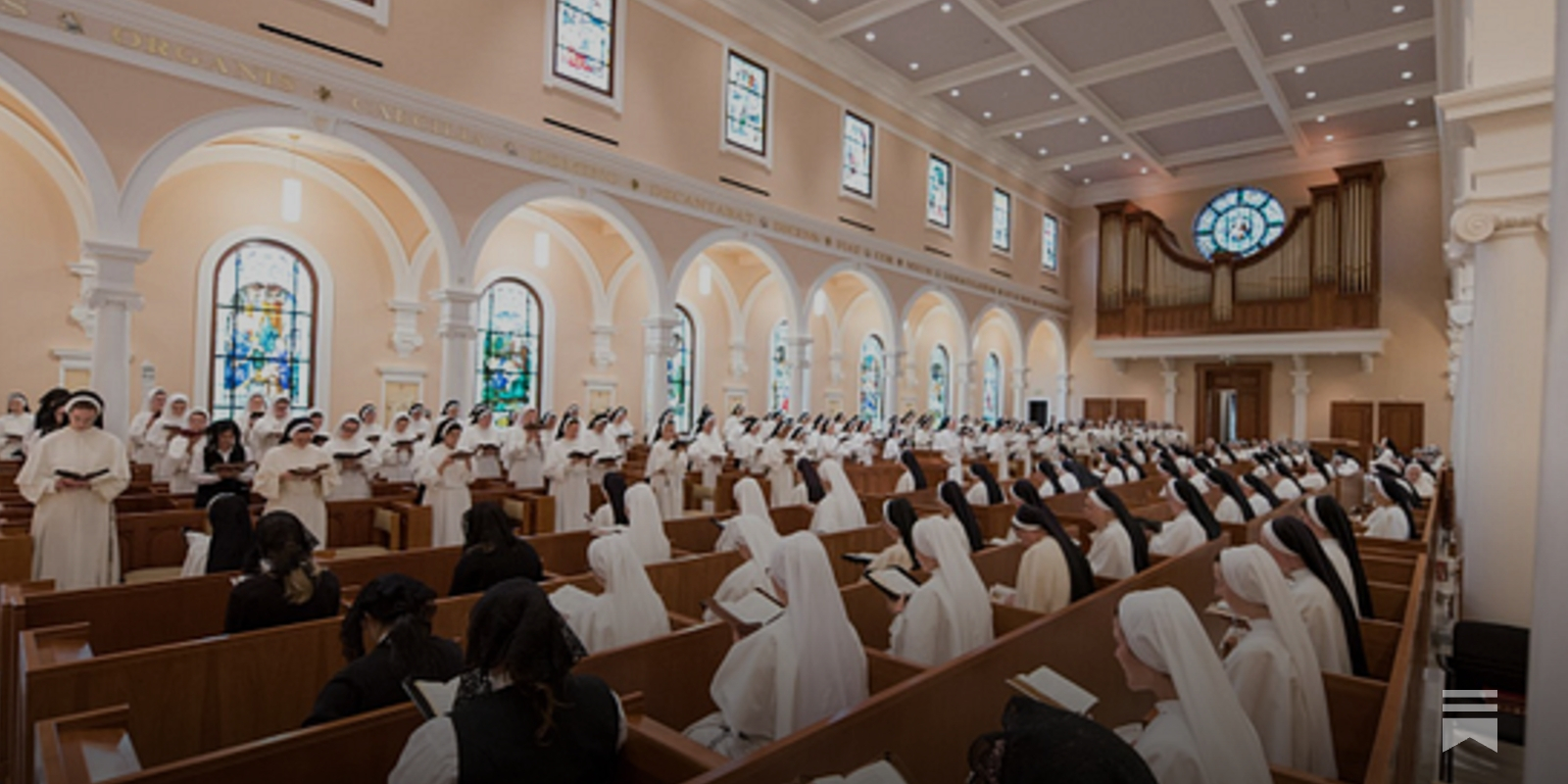
Around the time that the Sisters of Charity welcomed their last new member, another community welcomed a record number of postulants — a trend that started in the Church’s Jubilee Year 2000 and has continued to this day.
The Dominican Sisters of St. Cecilia, popularly known as the Nashville Dominicans, was founded in 1860. The community now has more than 320 sisters, according to Sister Mara Grace Gore, O.P., the community’s vocations director.
In 2000, the community had a record number of postulants enter — 22. Today, the community admits an average of 15 to 20 new postulants annually.
“The Second Vatican Council released beautiful documents on religious life and so the leadership we had at that time ensured that each sister got a copy of those documents and that we studied them and talked about them and really sought to live in the heart of the Church.” Gore told The Pillar.
“We really saw this fruit of the Jubilee, and the stability in who we are as Nashville Dominicans in this time and age. There was a lot of prayer about who we are and who the Lord’s calling us to be.”
As a steady number of women have continued to join the community each August — the sisters prepared to welcome 21 women this month — leaders insist that numbers are not a singular metric of success. They say instead that they aim to see each woman’s vocation as a gift.
“Each vocation is such a precious gift, an inestimable gift,” Gore said. “There is such a depth of mystery hidden beneath each vocation. Why is the Lord calling so many women to our community? We just bow before that mystery in some ways, and thank Him for that gift.”
Like other vocation directors, Gore said that women are drawn to the sense of authenticity found in communities with deep spiritual and historical traditions.
“Many women have found that communities that have deep roots are ones that have this authenticity that is attractive,” Gore said. “When young people encounter a living tradition generations old, there is this attraction to it.”
More recently founded communities, like the sisters of the Society of Our Lady of the Most Holy Trinity, (SOLT), a missionary community founded in 1958, also say authenticity plays a huge role in drawing women.
“There is a great desire for authenticity that they haven’t found or are not experiencing in the world,” Sister Mary Claire Strasser, SOLT vocations director, told The Pillar.
“Part of our charism is authenticity in relationships, especially to those we serve on missions. Women are drawn to that authenticity. They also desire to give themselves fully and completely as a spouse of Christ.”
Ultimately, women discerning want to give everything to Christ, vocations directors said.
“For those discerning, there is a great nobility of soul and a great desire to be all in for the Lord,” Gore said.
Support The Pillar
For her part, Borneman cautioned against centering the Church’s vocations crisis in particular religious communities.
“We have to look broader when we consider the term ‘vocation crisis’ and recognize that we should not shame or cast blame on women religious communities by saying, ‘If only they do this ministry or pray this way, or dress this way, then they will have more vocations,'” Borneman said.
“We need to have a little wider lens to see that there is an urgent need for the entire Church to promote vocations.”
“The question is: how can we help young Catholics today to discern this response to God’s call, rather than looking at it from an angle of shame or blame?”
Sjoberg agreed.
“The vocation crisis is a trend that just happens to be happening right now,” Sjoberg said.
“Since the numbers are lower — much like they were around the French revolution — this is an opportunity for great saints to arise. In our time, we have seen many greats like St. John Paul II, Mother Teresa, Blessed Carlo Acutis, and Pier Giorgio Frassati, that we can celebrate and I think we are seeing an uptick of interest and of entrance because of that witness.”
—
Sister Emily Marsh, FSP, of the Daughters of St. Paul has been the community’s vocation director for seven years. After a sharp decline in vocations, following a boom of the ’60s and ’70s, the community’s numbers have stabilized in the past decade.
Every year the community welcomes between two to six new postulants. But Marsh said her vocations work has shown her a deeper human crisis for young Catholics. It’s a crisis of interiority, she said.
“It’s hard to have an interior life with all the distractions of the world and technology which has increased anxiety and mental health struggles,” Marsh told The Pillar. “There are still young people listening and desiring to know his will. It is just hard for them to hear.”
“God never stops calling and people never stop responding.”
Sr. Gore concurred, emphasizing a crisis of faith, more broadly across the Church.
“We don’t really have a vocation crisis, we have a crisis in faith,” Gore said. “A vocation doesn’t just come out of nowhere. A vocation is a call from God to live for Him in this way of radical poverty, trust, and obedience, to lay down their life for the church.”
“That comes from a living relationship with God.”
—
But amid the challenges for religious vocations are the challenges of the Church’s own leadership and culture, said Sister Theresa Aletheia, who in 2023 helped found the Sisters of the Little Way of Beauty, Truth, and Goodness, a private association of the faithful, which aims to be approved eventually as a religious institute.
The community says it lives “a mission of listening, healing, and reparation in solidarity with people on the fringes of the Church, especially those who have been wounded, scandalized, or abused by members of the Church.”
Aletheia told The Pillar that in her view, “more vocations is not necessarily a sign of health — in a particular community or in the Church in general.”
“Promoting vocations begins with the crucial step of ensuring health in religious communities,” Aletheia said. “Health is not always clear from the outside. A community could be ‘booming,’ and in reality be very unhealthy.”
Aletheia said that setting a growth as a goal can lead to unhealthy tendencies in religious life.
“The motivation for new communities to acquire new members at any cost leaves many men and women as collateral damage. Large groups of incoming postulants also help a community receive donations. All that to say, communities have many motivations, aside from the good of an individual, to admit someone.”
She encouraged that assessment of religious life look at retention rates, in addition to initial vocations. And she emphasized the prospect of abuses in religious communities.
“A community oriented toward human flourishing in the long term would need to address abuses in the religious life openly and humbly so as to attack the roots of these repellant weeds that cause trauma for people and can ultimately lead to later departures of professed members,” Aletheia said.
“This deeper, more difficult work does not make itself apparent in flashy vocational pamphlets but is instead evidenced in the long-term structural health of a community.”
Similar to the experience of male religious communities, as reported by The Pillar, women vocation directors say that they have encountered in recent years a growing number of women expressing a general interest in religious life.
“There are a lot of women who have just met us at a conference or at a university who are just interested in learning more about us as a community and sisters, many are not even sure if they’re called to religious life, but they are definitely wrestling with it,” Sjoberg said. “We try to reach out to people at every stage of discernment and just help them discern God’s call.
But introducing young women to their communities — or even to religious life — proves to be a challenge. Most women did not grow up around religious sisters and thus many communities are foreign to young minds.
“I have heard many women say to me: ‘We see priests all the time, but we never get to see sisters,'” Gore said. “Trying to make ourselves available to be present so that young women have more of a familiarity with religious life and the opportunity to ask the question if the Lord has put that on their heart is a huge priority.”
Various communities have different approaches to meeting women. Some embrace social media, and find that a large number of applicants first discover them online. Others choose to rely on in-person encounters, through the community’s apostolates at parishes and in schools.
One common strategy, though? The suitcase.
“Instagram is a huge piece of helping people meet us, but there’s only so much you can know about a person or community through social media,” Strasser said. “Thus, I do a lot of traveling. The FOCUS SEEK conference is one place where we really strive to encounter young adults and invite them into mission. And we have been going to different college campuses and spending four or five days to introduce our community by being ourselves on campus.”
The real work happens in person, meeting with discerners one-on-one.
Invitation is key. A huge component for women discerning is visiting the various communities and feeling welcomed into their communal life, a key distinction from men’s discernment, the vocation directors said.
“A friend in a male religious community told me that men will watch from afar and then decide to enter religious life while women will want to be involved and be present and then decide to join,” Strasser said. “The nature of a woman’s heart is very communal and relational-oriented. They want to be invited to spend time with the community before formal entry or even a formal come and see experience.”
Each community that spoke with The Pillar, has adopted a longer discernment process in recent years. The SOLT sisters require women to participate in an aspirancy discernment program, living at a community mission in North Dakota, for up to a year. Many other communities require that discerners attend come-and-see retreat weekends and regularly meet with the vocation directors.
Many women discern for more than a year before even asking for a formal application, vocations directors said.
Several vocations directors emphasized their aim of prioritizing the spiritual health of discerners, rather than hoping for a “yes.” But several also noted that God seems to be moving in the hearts of young women interested in religious life.
“There really does seem to be this Eucharistic revival that’s happening in our Church — – the American church particularly,” Strasser said.
“I think we’re seeing a new generation of young Catholics more on fire with the faith. There’s the JP2 generation and now we are going to enter into the Pope Leo generation.”
“Seeing all the efforts the American Church has made in the last few years to evangelize and pursue revival, I think we are going to start to see the fruits of that in the near future.”
Read more on pillarcatholic.com

