






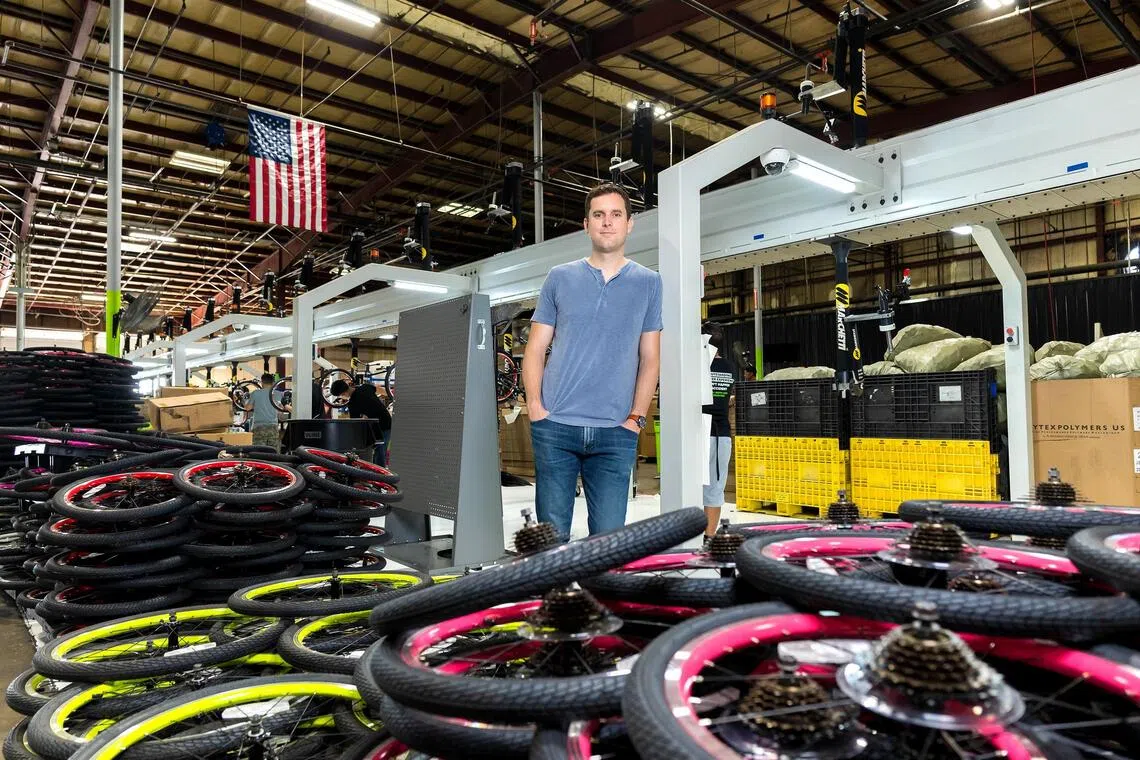
AUSTIN, Texas – Mr Brian Riley has confronted hard truths in his 15-year quest to become the sole manufacturer of children’s bicycles built entirely from scratch in the US.
The 38-year-old from Austin has seen for himself how decades of offshoring have hollowed out the country’s production capacity, making it difficult to build even a relatively simple product, such as a child’s bike, in the US.
But he did not give up. His company, Guardian Bikes, today has an annual revenue of US$100 million (S$130 million) and his bikes are nearing a milestone of being fully made in the US.
The unique proposition of his high-end bikes for children, priced at US$150 to US$400 each, is a safety-enhancing braking system. He developed the idea after watching his grandfather’s painful recovery from a bike accident – the elderly man had braked too hard and was thrown over the handlebars and suffered a broken neck.
Mr Riley got his big break on Shark Tank, a reality TV show where entrepreneurs pitch their ideas in the hope of attracting funding. In his 2017 appearance, he made a pitch for US$500,000 to make children’s bikes featuring his patented braking system.
An investor liked the pitch and the products. Mr Riley got the US$500,000 in return for a 15 per cent equity stake.
At the time, not a single bike brand sold in the US was being manufactured in the country.
Before this, Mr Riley had made the rounds of big US bike companies to sell them his technology, until he realised that all bikes were being made in China. When he first decided to venture into manufacturing himself, he too relied on Chinese factories.
The turning point came when the Covid-19 pandemic forced sudden lockdowns across the world, and the supply chains that linked factories in China to consumers in the US snapped. He decided to relocate production to the US to have better control over his product.
In 2022, he set up a plant in Seymour, Indiana, a location from where he could ship his bikes anywhere in the country within two days. The town also had steel mills that could supply the essentials to make bike frames. And he could tap a skilled workforce that had been laid off from nearby auto plants.
Not having to keep a large inventory to guard against supply chain breakdowns and saving on shipping costs were advantages too. Still, the move was not easy.
“The supply chain for bike parts no longer exists in the US, so we have had to do a lot ourselves,” Mr Riley said. “And bike manufacturing hasn’t existed in the US for decades, so we’ve had to train people for these new types of jobs from scratch.
His 540,000 sq ft factory, which employs 250 people, now makes 1,000 bikes a day – or a bike every 30 seconds. It is an enormous leap from the lead time of six to eight months when his bikes were being made in China.
“Today, most of our frame production is highly automated, while assembly is still very human driven.”
The machines used to make the bikes, he concedes, are sourced from all over the world. And his dream of an all-American bike is still some distance away.
“A little over 50 per cent of the value of the bike is made in the US today,” Mr Riley said. “We are hoping to get that to 75 per cent next year.”
At the opposite end is Ms Elana Ruffman, now counting down to Nov 5 – an important day for her and for all of the US. That is when the US Supreme Court will begin hearing
the case against President Donald Trump’s tariffs
.
Ms Ruffman, 32, is the scion of a 50-year-old family-owned toy company in Illinois that sued Mr Trump after his
April 2 announcement of tariffs
on nearly every country in the world, challenging his authority to impose them under the International Emergency Economic Powers Act.
The toymaker won the lawsuit in a lower court in May, but the Trump administration appealed against the decision.
Ms Ruffman intends to be present in person as the Supreme Court prepares to hear oral arguments on Nov 5 in her company’s lawsuit, which has been bundled with similar cases brought by other small businesses and several Democratic-led states.
“Most of the products that we import from China went from having 0 per cent tariffs to the prospect of 145 per cent tariffs in April,” said Ms Ruffman, who is vice-president of marketing and product development at hand2mind, which specialises in making educational toys.
“Of course, the tariff policy has changed many times since then, but we calculated that our tariff bill would be US$100 million in 2025 if the tariff stayed at 145 per cent,” said Ms Ruffman. The toys made by hand2mind and Learning Resources, an affiliated company, are largely manufactured in China.
“We do some manufacturing in the US, but it’s just not possible for us to make our entire range of products here,” said Ms Ruffman. The toys, which have many components, need to be assembled and painted by hand. Labour costs make that prohibitive in the US.
On top of this, US factories, which operate at a large scale, are not keen to take their orders, she said.
“We don’t make products a million units at a time. We might make 5,000 or even 1,000 at a time, depending on the need. And so in the US, we are not a factory’s first choice for a customer,” she said, adding that factories preferred large orders and wanted to make the same product over and over.
Why she cannot make her toys in the US is a question she often answers in engaging TikTok videos.
The US manufacturing economy pales in comparison with China’s, she said.
“For example, the United States has 17,000 plastic manufacturers, China has 400,000; there’s a huge difference in scale. It would take a significant change in how we’re operating economically in the US to build our capacity. That’s not something that happens in a year,” Ms Ruffman added.
Some 500 employees at the company’s headquarters near Chicago package and ship the toys to retailers like Target, Walmart and Amazon, or a school district or a family.
So far, the company has chosen to absorb the blow from the tariffs.
“We raised the prices in the single digits. We did not pass the full cost of the tariffs on to customers. We did not lay off anyone,” she said. “We need to be able to pay people’s pay cheques every two weeks, that’s why we brought the lawsuit. We felt this was an existential threat to our company.”
If the re-industrialisation of the US is to have a fighting chance, workers like Mr Sergio Juarez will have a critical role to play.
These days, Mr Juarez can be found at the site of what may eventually be the world’s biggest artificial intelligence (AI) data centre, which is beginning to take shape at Abilene, a four-hour drive from Austin.
The flagship site of the US$500 billion Stargate project, equipped with Oracle Cloud infrastructure and racks of Nvidia chips, is meant to satisfy the world’s ravenous appetite for physical and digital infrastructure to power AI.
It is here that Mr Juarez, at age 42, landed the job of his dreams.
After graduating from high school, Mr Juarez hopped among a few jobs, first working at McDonald’s, then as a medical assistant. He also worked as a seismic graphicist helping petroleum companies locate gas and oil pockets for drilling.
After that, he spent a decade working across the country at construction sites.
“I did everything from flooring to framing, painting, roofing – every kind of skilled trade you can do in construction,” he said.
When he returned home to Brownsville, Texas, in 2022 to be with his family, the father of three could not find work. While applying for unemployment benefits, he learnt that the government would pay for him to learn a trade.
He initially thought he could learn welding, but administrators at the Valley Initiative for Development and Advancement (Vida) said electricians were more in demand. The non-profit organisation helps low-income, unemployed and underemployed people acquire job-related skills.
He completed a three-month course with Vida and was certified as an electrician.
Two weeks later, he was placed in a job at SpaceX, the pioneering US aerospace company headquartered at Starbase, Texas.
“We were installing lighting in the towers where they store the rockets,” said Mr Juarez, adding that he often saw chief executive Elon Musk on the premises.
“He would come to see his ‘playground’ as we called it. He would walk around and see all the work we’d be doing at his new buildings – the fixtures, the underground wiring, the new electrical door support.”
Mr Juarez worked at SpaceX for two years, earning US$31 an hour, nearly double the wages he had earned at his construction job. When the project came to an end, he promptly found work at the Stargate project in Abilene.
Leveraging his work experience and improving his skills with more training enabled him to earn US$53 an hour at his new job.
What is more, for the first time in his working life, he has a clear path for career progression. With further training, he can aspire to become a general foreman, with the promise of better pay and perks.
“It’s exciting to be a part of a project that not only the United States, but everybody in the whole world also knows about,” said Mr Juarez. “AI is the future now, and I feel like I am building the future.”
Inspired by his example, his 17-year-old son plans to follow in his footsteps.
Ms Felida Villarreal, president and CEO of Vida, says Mr Juarez is among the many successes at her organisation located in the Rio Grande Valley, which lies at the southernmost tip of Texas and borders Mexico. The region, with a population of about 1.4 million, is predominantly Hispanic.
“We suffer from high levels of poverty and low levels of education. Our programme provides resources and tools that are needed to find good jobs and achieve professional growth and development,” she said.
The key, Ms Villarreal said, was to work closely with local industry to understand what skills were needed. She cited sectors like healthcare and engineering, and specialised trades like welding, commercial electricians and plumbing as being in high demand.
The average participant in Vida’s training programmes is about 27 years old. Each cohort comprises about 900 students every year.
“It’s more of an adult learner population with family responsibilities like childcare. So we also provide wraparound support services,” she said.
She maintains that skilled students can sometimes earn a lot more than those with bachelor’s degrees. “Some of them are making six figures right in our region,” she said.
Vida’s work is meaningful but modest. A 2024 Deloitte study projected that by 2033, 1.9 million manufacturing jobs in the US would be unfilled due to skill shortages.
Not many economists are ready to say that the US is witnessing a second Industrial Revolution under Mr Trump.
To be sure, some eye-popping figures have made headlines in 2025; a mix of tech, pharma, auto and infrastructure companies together committed to investing more than US$1.3 trillion into manufacturing.
Apple led the field, promising Mr Trump that it would invest US$600 billion in plants across various states. Nvidia said it would plough half a trillion dollars to make AI chips and infrastructure.
TSMC of Taiwan also made waves for committing to plonk US$165 billion in its plants and research facilities in the US. Amazon said it was investing US$50 billion to build up its cloud infrastructure and data centres.
Pharma makers Johnson & Johnson, AstraZeneca and Roche announced investments of more than US$50 billion each.
More is to come. Mr Trump returned from his five-day trip to Asia with
more details on the US$900 billion
that Japan and South Korea said they would invest in the US.
The European Union has offered US$600 billion, with few details about where and when.
China has made overtures too. By some accounts, it wants to invest US$1 trillion in the US economy.
Mr Trump has made no secret that tariffs are a means to an end. Make it in America and you will pay no tariffs has been his mantra from day one in the White House.
Experts do not agree that bringing factories back makes sense. Some think it is a noble but lost cause.
“We do not see US manufacturing reviving. On the contrary, more manufacturing jobs have been lost this year,” said Professor Suzanne Berger, who co-directs the Massachusetts Institute of Technology’s newly launched Initiative for New Manufacturing. The initiative brings engineers, social scientists and economists together to deliberate on how to transform manufacturing.
In 2025, some estimates have put manufacturing job losses at 78,000. US manufacturing employed about 12.7 million people in 2024, accounting for about 8 per cent of total employment while contributing about 10 per cent of gross domestic product.
The uncertainty generated by the tariffs has dampened investors’ confidence, Prof Berger said, adding that the only activity that was booming was investment in data centres for AI.
Skills shortage, she said, was not a serious impediment in re-industrialisation given the “very slow pace of technological adoption” among manufacturers in the US. Young workers stay away from manufacturing jobs because of the historically low wages, she said.
Even if the US manages to revitalise manufacturing, it has little hope of catching up to China. The world’s second-largest economy produces one-third to one-half of nearly every manufactured product on the planet from steel to cars to ships.
As at 2023, China’s manufacturing value-added, measured in nominal dollar terms, was US$4.7 trillion, while the US’ was US$2.9 trillion. China accounted for 29 per cent of the world total of US$16.2 trillion, while the US accounted for just 18 per cent.
Thus, China’s manufacturing output in value terms is about 62 per cent larger than the US despite having an economy that is 36 per cent smaller, pointed out Mr Stewart Paterson, senior research fellow at the Hinrich Foundation.
It is also still cheaper to just make in China. Average manufacturing wages in China stand at US$12,800 per year – about 12.5 per cent of the US level.
Additionally, the cost of complying with US regulations on health and safety, the environment, tax and homeland security are significantly higher than in China.
What could be an even bigger problem is that the US lags China in advanced manufacturing, the use of innovative technologies to enhance the design, production and delivery of products.
China installed nearly 300,000 robots in its factories in 2024, more than the rest of the world combined. More than half were made domestically. The US installed only 34,000 robots, most of which were imported from Japan and Europe.
In sum, odds are stacked against the return of manufacturing to the US.
But a concerted effort may pay off, said Mr Paterson.
“If the goal of the current administration is to reverse the decline in US manufacturing… then the pure economic arithmetic looks challenging but plausible over perhaps 10 years,” he said.
Securing supplies from like-minded allies would stand a far higher chance of success, he suggested.
Prof Berger said an important factor was the political consensus that manufacturing was vital to national security and defence.
“Both Republicans and Democrats agree this is critical, which is a reason for optimism,” she said.
Mr Riley, the bike-maker, said fervour counted too.
“There is a movement developing of entrepreneurs who want to manufacture in America,” he said. “We are going to see major re-industrialisation in the US in the next 10 to 20 years,” he predicted.
Read more on The Straits Times

