






Sir Ridley Scott once described the art of storyboarding as the first look at a film. Similarly, a prototype is a first, typical, or preliminary model of something made. When people discuss prototypes, they often frame them as a rough draft or a “first version.” Prototyping is a culture and art form; a way to collapse an idea into something tangible enough that you and others can react to it. Prototypers can immediately shut up performative talkers by proving through their actions.
The best prototypes don’t just validate feasibility; they change the conversation about what should exist in the first place. The trick is remembering that a prototype isn’t a miniature version of the final product. It’s a tool to answer a question. That’s why some of the best prototypes are disposable — they live just long enough to teach you something and then get thrown away.
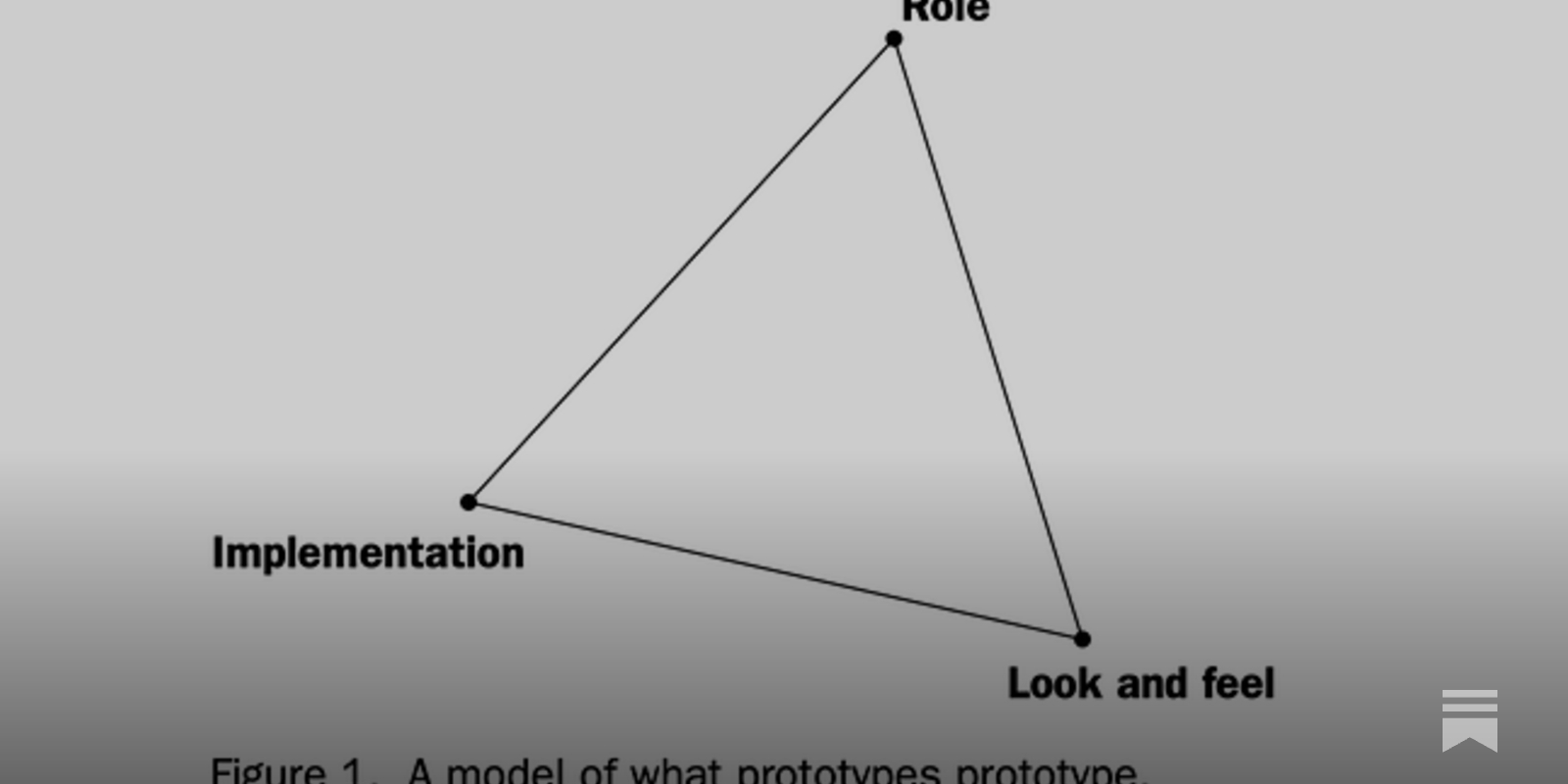
In 1997, Stephanie Houde and Charles Hill wrote a paper called, What do Prototypes Prototype? Their framework remains one of the clearest ways to think about the practice. A common mistake in making prototypes is having an unclear intention of what questions the prototype is meant to answer. As a result, several prototypes are solution-oriented with a nice-looking demo but no clear learning objective. Houde and Hill break the prototype framework into three categories:
Role: What is this product’s purpose in someone’s life? For example, does this wearable make you feel more connected to your health, or does it become just another notification source?
Look and feel: What does it feel like to use? This is about texture, motion, pacing, and emotion — the subjective qualities that don’t show up on a spec sheet.
Implementation: How would it actually be built? This is where you test whether your stack, APIs, or infrastructure can support the concept.
What makes this framework powerful is that you don’t have to prototype everything at once. You pick one lens, focus on it, and let the prototype do its job.
I will give you the most honest answer: there is no ideal prototyping tool. It’s not one you pick and pay a monthly subscription to. The reason is that prototypes for Role, Look and Feel, and Implementation all rely on different toolchains. As they say in the 60 Second Prototyping talk at WWDC, “Subvert your tools.” Here are a few quick tips to get you started.
The best prototypers favor momentum over perfection. Over multiple iterations, it leads to perfection. The ability to keep the loop of idea → build → learn → adjust, moving which leads to perfection.
The value of prototyping is less about the artifact made than the lessons learned from showing it to customers and stakeholders. Prototype artifacts must be charged by output, method, and insights. As you build your own prototyping ability, you learn key skills along the way:
In practice, you often learn that the problem isn’t at the surface layer. A Look and Feel prototype may fail because of an Implementation challenge, not the UI. A system idea may succeed because of a tiny moment of delight. Prototypes reveal these truths faster than any slide deck.
Prototyping biases towards action and feasibility over UX Theater. The act of making and putting things together will naturally expose the opportunity areas to improve. It collapses the distance between idea and impact. If you can make something tangible, you change the conversation: people stop arguing in the abstract and start reacting to the real.
In a business context, this is gold. A good prototype can align executives faster than a strategy deck, unlock resources, or show customers a future they didn’t know they wanted. Teams that build prototypes consistently are not just faster — they’re more aligned, because they’re always working from a shared artifact.
Read more on proofofconcept.pub

