






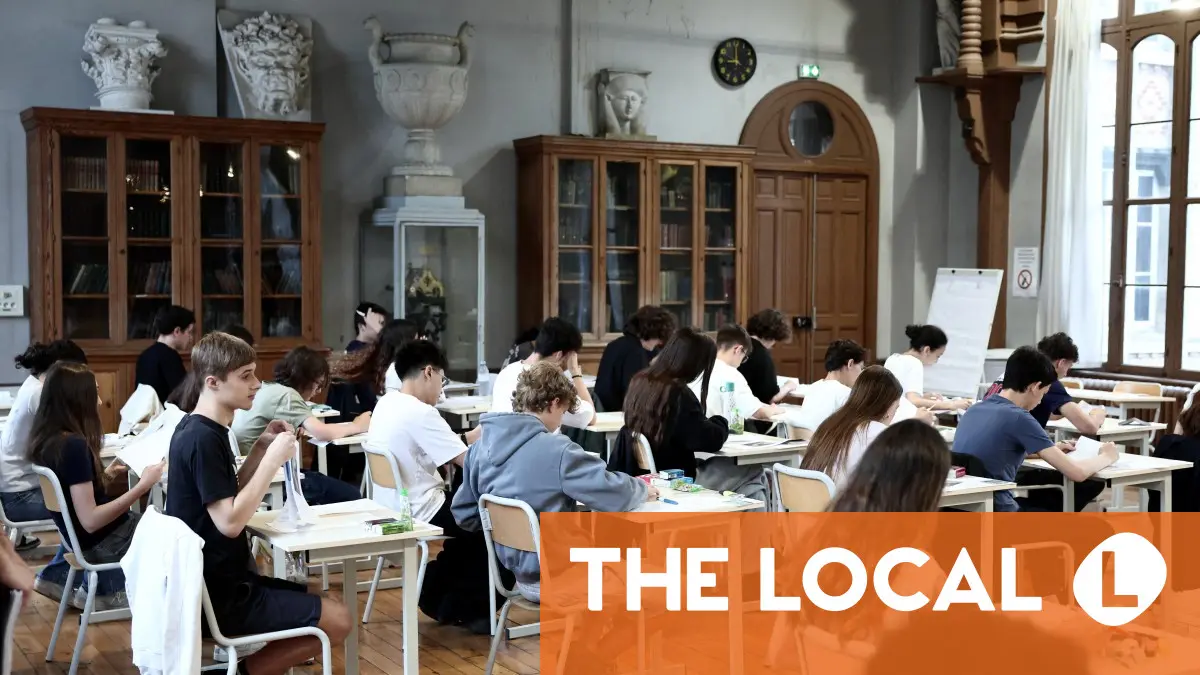
As 12 million students – and some 850,000 teachers – prepare to return to classrooms across France on Monday, September 1st, here’s what they can expect from the start of term.
In June 2026, the brevet – the exams that 14 and 15-year-olds take – will see the weight of its final exams increased. Final exams will account for 60 percent of the overall grade, while continuous assessment will account from the remaining 40 percent, compared to 50-50 split of previous years. Continuous assessment will be based on the average of the grades obtained throughout the troisième year leading up to the exam.
Sex education
This is the most talked about new feature. Starting in September, a programme for education in emotional, relational and sexual life will be implemented to include three annual sessions on the topic.
This programme, published by the Ministry of National Education in February, provides for learning in several stages, in all écoles, collèges and lycées. It discusses sexuality, consent, emotional relationships, and gender identity.
Proponents of the programme, including all the teachers’ unions, see it as a vital tool to reduce sexist and sexual violence. But some conservative groups and parents have referred the programme to France’s highest administrative court, the Conseil d’Etat.
In general and technological streams, students in the première class at lycée (ages 16 and 17) will take an early maths exam in June 2026.
The aim, according to the Ministry of Education, is to ensure students master “fundamental skills and automatic responses such as solving equations, calculating proportions and probabilities, and interpreting statistical indicators”.
In addition to raising overall standards, Elisabeth Borne also wants to encourage girls to take more math and science classes.
Additionally, starting in September, teachers will be better trained in gender bias to ensure that girls are questioned more often in class. In quatrième and troisième classes at collège (ages 13-15), science classes with flexible schedules will be trialed in seven school districts (Amiens, Bordeaux, Créteil, Martinique, Nancy-Metz, Normandy, and Poitiers).
The goal is to have 50 percent of girls specialising in mathematics in their final year of lycée by 2030, compared to 42 percent currently.
Meanwhile, to reinforce basic skills in maths and French, new programmes will be implemented for children from the age of three, according to the 2025 back-to-school circular. “While reading and arithmetic remain priorities, writing, an essential skill for our students’ success, must be given our full attention,” it states.
In cinquième – the second year of collège – national assessments will be mandatory for all students from 2025. As for streamed teaching in maths and French, they will continue in the first two years of collège, but their implementation for the two following years has been canceled by the minister.
From September, students at collège will be required to leave their phones at home or hand them in to school staff, as a trial introduced in around 100 schools last year is rolled out nationwide. According to the government’s circular, the trials were “positive in terms of the school environment, the serenity of students and staff, and students’ readiness to learn.”
How the policy is implemented at schools will be at the “discretion of school principals, in conjunction with departmental councils” according to the government.
READ ALSO 9 essential back-to-school websites for children and parents in France
Physical tests
Starting at the beginning of the school year, pupils at sixième in collège will take physical fitness tests at the beginning of the year during physical education classes after a trial of more than 4,000 students in 2024 found that only 19 percent of children had ‘satisfactory’ levels of physical fitness.
Career guidance
To improve career guidance for students in collèges and lycées, and after graduation, a plan called Avenir will come into effect in September. From cinquième through to the final year of lycée, students will follow a career guidance programme with four half-days dedicated to this topic each year.

