






1.35pmSchool of Rock director’s tribute to Godard captures spirit of French New Wave
Hello and welcome to this week’s film review wrap – the big movies landing in cinemas this week.
If you want to stay in touch with all the latest movie news from across the globe, as well as reviews, please sure to sign up to our newsletter.
Must-see movies, interviews and all the latest from the world of film delivered to your inbox. Sign up for our Screening Room newsletter.
Share
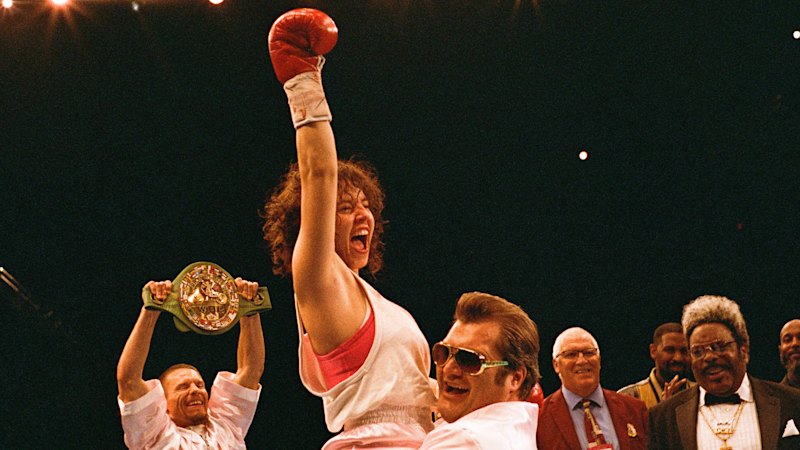
Christy ★★★★
(MA) 135 minutes
Among great screen actors, relatively few are known for embracing the art of physical transformation. Meryl Streep is one. Christian Bale is another and Charlize Theron abandoned all semblance of vanity to get inside the skin of the convicted killer, Aileen Wuornos, in Monster.
Now it’s Sydney Sweeney’s turn. She was already on the rise in 2023 when she showed just how good she could be in Reality, a small film about a government whistleblower being interrogated by the FBI. But in Australian writer-director David Michod’s new film, Christy, she becomes a chameleon.
Christy Salters Martin is no killer but the role did require Sweeney to set aside all the attributes which turned her into a Hollywood “it girl” after she played an appallingly spoilt teenager in the first season of White Lotus.
To inhabit the part of Christy, a woman who punched her way through a particularly tough section of the glass ceiling in the 1990s to become a women’s boxing champion, she put on 14 kilograms, adopted a variety of ingeniously unflattering hairstyles, and assumed a ferociously competitive attitude which has her badmouthing her opponents as a matter of routine.
Some critics have written the film off as a standard biopic, which I find hard to understand. Apart from the intensity of Sweeney’s performance in and out of the ring, there’s the brutality she endured at home at the hands of her husband and trainer, Jim Martin (Ben Foster).
She was 22 when she agreed to marry him – even though she was gay, and he was 25 years her senior – because she was convinced that he could boost her career. Big mistake. From the moment you set eyes on his blond comb-over, you can tell that Martin is a duplicitous sleaze.
Christy is a high school basketball champion from a small town in West Virginia when she’s spotted by the boxing manager who introduces her to Martin. It’s her pugnacity on the court that catches his eye and the same quality wins over Martin, who has no desire to train a woman until he watches her perform.
She puts up with his abuse because she comes to believe that her career depends on it. It’s a level of dependency that keeps many women tied to men they fear and detest: the relationship is bound up so tightly in her sense of self that she can’t imagine achieving anything without him.
It’s not until she learns that he’s been stealing from her that her anger takes over. Even so, she underestimates his capacity for viciousness and the end is so violent that it strains belief.
Michod has attracted criticism for failing to put more grit in the mix in the scenes dealing with Christy’s training sessions and routines as she rises to the top, but he catches all the showbiz hype and the flashy posturing that the boxing world thrives on – as does Christy herself when she finds her place in it.
Her family, too, is seduced by it. Her mother, Joyce – a brilliant portrait in passive aggression by Merritt Wever – rivals Martin in being a character you love to hate. Desperately afraid that her daughter is going to scandalise the neighbours by coming out as a lesbian, she welcomes the arrival of Martin in her life as if he were Galahad reborn.
But it’s Sweeney’s film. Bristling with energy and ambition, her Christy is an appealingly indomitable figure with a sharp sense of humour. You’re with her all the way as she finally gets back in touch with her urge to survive.
Share
Grand Prix of Europe
★★½
(G), 98 minutes
How many Australian children are familiar with Ed Euromaus and Edda Euromausi, the cheery blue-eyed mice who serve as mascots of Europa-Park in north-east Germany? At a guess, not as many as dream of being taken to Disneyland.
Still, the park, founded in 1975, attracts millions of visitors each year, while remaining in the hands of the Mack family, who have been in the fairground ride business for over a century and continue to supply rollercoasters to funparks around the world.
Half-a-dozen Macks are listed as co-producers of Waldemar Fast’s Grand Prix of Europe, their company’s first ever foray into feature filmmaking, with some assistance from Warner Bros. Originally the dialogue was in German – but as usual with digitally-animated family films from outside the Anglosphere, what we’re getting is the English-language dub, with Ed and Edda voiced by Thomas Brodie-Sangster and Gemma Arterton respectively.
Not wholly surprisingly, the story begins at a family-owned amusement park, the pride and joy of Edda’s hardworking dad Erwin (Lenny Henry). But compared to the sprawling Europa-Park the attractions are modest: a shaky-looking rollercoaster, a merry-go-round prone to mechanical failure, and a fortune-teller booth operated by a bespectacled mole (Ayesha Antoine).
Even in talking-animal land, the economic pressures are real. Erwin has given up hope of paying off his debts, when coincidence comes to the rescue: it so happens that the annual Grand Prix of Europe is about to kick off, that Edda is an aspiring race car driver, and that Ed, the arrogant reigning champion, looks so much like her he could be her twin brother.
Still more conveniently, Ed injures his arm, leaving him unable to compete. Technically this is Edda’s fault – but rather than withdraw, Ed agrees to let her secretly take his place, with the prize money to be split between them.
With half an hour’s worth of set-up out of the way, we’re onto the Grand Prix itself, a series of increasingly chaotic street races held in Paris, the Swiss Alps, the coast of Italy and finally London, with the competitors travelling by zeppelin from one location to the next.
Like the recent Pets on a Train, the film resembles a video game transferred to the big screen, stronger on design than anything else. I liked the sunsets we glimpse through the windows of the zeppelin, and the maroon leather jacket Edda favours when not in her official racing gear.
But I soon grew tired of the sparring between Edda and Ed, who get on each others’ nerves so consistently it seemed possible they really would turn out to be long-lost siblings, especially when we learn that Ed grew up in an orphanage.
Nothing comes of that, but then the plotting is careless in general: the most effective villains are a pair of feline bruisers named Mittens (Matt Moselle) and Fluffy (Nate Begle) who loom over Erwin at the outset then vanish completely. Raising such objections always seems like joyless nitpicking, but I’ll bet the Macks are a good deal more meticulous when it comes to their rollercoasters.
Share
FILM
Nouvelle Vague ★★★★
(M) 106 minutes
Reviewers are meant to be impartial, so where Richard Linklater’s Nouvelle Vague is concerned I should declare my bias upfront.
I might never have thought of writing film reviews at all, if not for the cinematic movement known in English as the French New Wave – in particular, the core group of directors who started out in the 1950s as critics for the legendary film magazine Cahiers du Cinema.
Among the most brilliant of these critics-turned-filmmakers was the late Jean-Luc Godard, whose 1960 feature debut Breathless – a low-budget crime thriller dedicated to the US B-movie outfit Monogram Pictures – is now recognised as a landmark in film history, as important in its way as Citizen Kane.
There’s an outward paradox in a film about the making of Breathless conceived by Linklater, the extremely American director of School of Rock. But Linklater has long had his own relation to French culture, and since most of the New Wave directors survived into the 21st century, it’s more than possible he crossed paths with them at one festival or another.
Most crucially, he’s a genuine fan, much as Godard and his fellow Cahiers critics were fans of Hollywood from afar (School of Rock too is a movie about fandom and wanting to emulate your idols). In fan mode, he’s done all he can to get the details right, in collaboration with his French cast and crew (the script was originally written in English by Holly Gent and Vincent Palmo, but has been translated and reworked by a French team). The cinematographer David Chambille does a seamless job of capturing the flavour of the early New Wave, shooting on film in black and white with period accurate lenses.
Dozens of real people associated with the New Wave appear as characters – and in every case Linklater and his casting team have taken care to match the actor to the role, even if they’re only on screen for a moment. Captions pop up to identify each of these people by name, though without supplying further detail, implying that if you don’t know who Pierre Kast or Marilù Parolini was, perhaps you’d better go find out.
Guillaume Marbeck is a very credible Godard, faintly awkward yet full of physical energy, and a genuine mystery man (the trademark dark glasses stay on throughout). Better still are his co-stars, who superbly embody the leads of the film-within-the-film: Zoey Deutch as the increasingly impatient American import Jean Seberg, and Aubry Dullin as Jean-Paul Belmondo, a laid-back cut-up who takes his director’s antics in his stride.
This isn’t Breathless, of course: in contrast to Godard’s freewheeling approach, to call Nouvelle Vague a museum piece wouldn’t be entirely unfair. But it’s an experimental film too, in its own way. Linklater sets himself the challenge of keeping us interested in the day-by-day chronicle of a film shoot, underlining the tensions between the key players without departing too far from the historical record.
The dramatic core is the running battle between Godard and Seberg, which is never fully resolved; here perhaps Linklater and his writers do embellish a little, but justifiably so, in the interest of doing justice to Seberg’s side of the argument.
This is also a film addressed to its own historical moment (there’s some irony in the fact it was bought by Netflix). Total pro though he is, Linklater has nothing but admiration for Godard’s inspired amateurism – his willingness to work without a finished script, catch his actors off-guard, shrug off warnings about continuity errors, and generally reinvent the art of cinema as few filmmakers dare to today.
Share

