






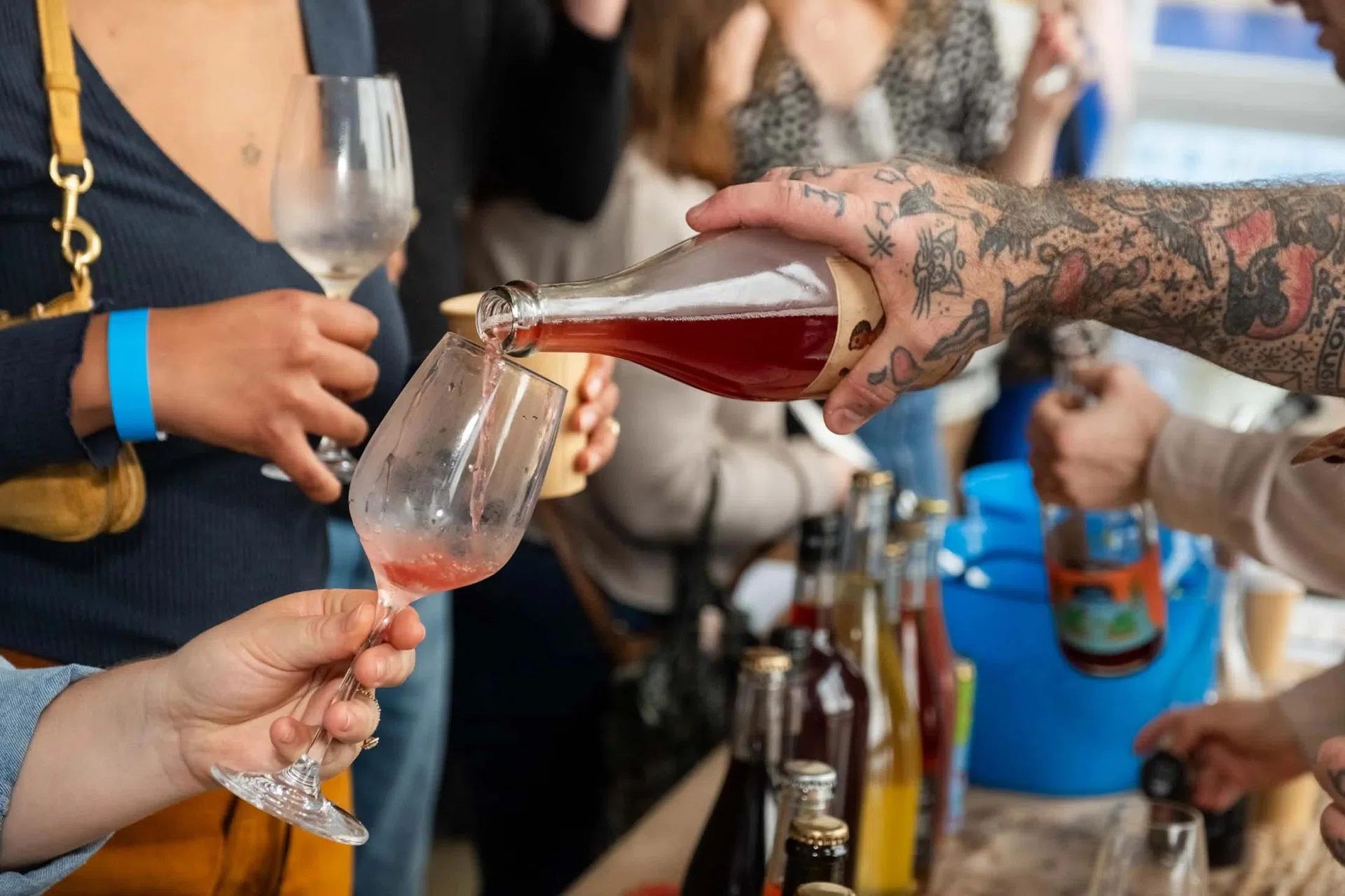
[NEW YORK] In a Brooklyn warehouse in early November, the 2025 New York Raw Wine fair was buzzing with drinkers hunting the latest in natural wine. Casually clad vignerons and importers poured for an enthusiastic crowd sporting beards, wool beanies (it was cold), fleece vests, worn jeans, scuffed boots – long the natural wine uniform.
The vibe was more subdued than the tribal exuberance at the first Raw Wine fair in London in 2012. Back then natural wine was a small-group rebellion against conventional winemaking, with charters and manifestos declaring the organic viticulture and no-additive principles they stood for. Drinking the wines marked aficionados as the anti-authority “cool kids” who valued transparency, authenticity, nature, the environment and tiny iconoclastic producers with a romantic story over corporate wine titans. The wines came with countercultural, not-your-parents’-vino appeal.
Today natural wine is no longer niche. A look at Raw’s 2025 itinerary shows its current reach: Besides its New York event, the fair made stops in Berlin, Copenhagen, Montreal, Paris, Shanghai, Tokyo and Verona, Italy. This spring it will add Shenzhen. Bottles of fizzy pét-nat, savoury orange wine and minimal intervention appear on Michelin-starred restaurant lists, and hardcore no-sulphur-added examples and wine bars are touted in Vogue.
It is easier than ever to find them. The number of global spots offering natural wine increased 60 per cent from 2021 to 2024, according to French app Raisin’s latest report.
Paris is still the world capital, with almost 600 venues in 2024, while Italy has seen a 35-fold increase in spots since 2016. The app lists 3,870 bars and 3,428 wine shops, in 2,313 cities in 35 countries where at least 30 per cent of the wine selections meet the criteria for Vin Méthode Nature, a formal voluntary charter under the French Ministry of Agriculture. Isabelle Legeron, the founder of Raw Wine, says the scene is fizzing in Montreal and Tokyo.
All of which illustrates how this major 21st century wine movement has gone beyond fad status. According to research firm IWSR Drinks Market Analysis, though overall wine consumption is declining, demand for natural, organic and other alternative wines is rising. Who’s drinking them? Generation Z and especially millennials.
Across all markets surveyed by IWSR, 31 per cent of regular wine drinkers were aware of natural wine in 2024, up from 26 per cent in 2021. In the US, specifically, 18 per cent had sought to purchase it in the previous six months; in the UK, 11 per cent.
A September 2025 report from DataIntelo Consulting projected the global natural wine market would reach US$3.66 billion by 2033, up from US$1.48 billion in 2024.
“Natural wine is becoming wine, it’s past trendy,” says Alice Feiring, author of two books and a Substack on the topic. It has influenced how grapes are grown, how mainstream wine is made and how we think about wine. The line between the naturalistas and other high-end artisanal producers is getting blurrier. Some hardcore proponents aren’t that happy about the big-tent approach.
First of all, natural wine has helped reawaken and shift demand to lighter, fresher wines with more purity, zing, energy and personality as opposed to the once-popular oaky and powerful alcoholic ones.
In viticulture, organic and biodynamic farming resonate with both today’s health and environmentally conscious drinkers and an ever-increasing number of winemakers worried about climate change. The global organic wine market, of which natural wine is a subset, is expected to triple in value by 2030, to US$25.1 billion, with a compound annual growth rate of 11.3 per cent, according to a recent report by InsightAce Analytic.
In winemaking, more producers are following natural wine’s low-intervention tenets: fermenting with native yeast; avoiding additives, dyes and high-tech fixes in the cellar; and reducing the amount of sulphur they use as a preservative to protect freshness and flavour, though few have adopted the no-added-sulphur natural wine ideal. (Many say this is actually a return to traditional winemaking, before the advent of chemicals.)
Although ties to headaches and health concerns have roundly been disproven, and only a tiny percentage of drinkers have an allergy to sulfites, high levels of added sulphur can mask a wine’s aromas, flatten flavours and generally cause a wine to “lack life.”
At the same time, natural winemaking overall has improved. Choosing one is no longer like playing Russian roulette with your tastebuds. A decade ago, too many of the examples I tasted reeked of barnyard or nail polish remover aromas and cidery or funky tastes – or, even worse, mousiness, a hamster cage character that’s repulsive and can be avoided by adding sulphur. Drinkers sometimes complained that wines tasted weird and crazy, not just wild, and inconsistent from bottle to bottle.
Feiring blames these stumbles on sudden demand starting in 2015 or so, when natural wines were in short supply and new producers often lacked skill and released their wines too quickly. (Big producers of mainstream wines value consistency over excitement, especially in the lower price range. Using sulphur ensures a certain level of consistency, while no sulphur is riskier.)
Top importers insisted they clean up their act and rejected wines that had problems. Some winemakers now add small amounts of sulphur before bottling to cut down on risk and consciously aim to make their wines more acceptable to mainstream drinkers. Other producers have collaborated to figure out how to prevent flaws without compromising their ideals.
The movement also smashed a lot of white-tablecloth elitism connected to wine drinking and made it seem more egalitarian and, yes, fun, helped along by amusing hand-drawn labels, the rise of Instagram and the proliferation of casual, unstuffy wine bars.
The stereotype that it is hard to find tasty natural wines lingers. Many drinkers still have a negative image of the whole category because of past encounters with flawed bottles. Just as no wine region is universally of high quality, even for conventional wines, so it goes with natural wines.
And given how widely the term “natural wine” is used today, aficionados sometimes find it difficult to identify just what qualifies – there are still no legal standards for defining natural wine.
A few years ago the French wine industry introduced the private voluntary certification Vin Méthode Nature, and some 300 winemakers from 12 countries adhere to the standards of VinNatur. Both codify required farming and winemaking practices but are still divided on how much sulphur can be added, from none to less than 50 milligrammes, which is still very low.
For purists, no added sulphur is key. Only about a third of wines at the Raw Wine fair fit that requirement. The term to look for on labels is “no added sulfites” or “sans soufre.”
I’ve found the most reliable examples of these come from well-known producers, such as Domaine Binner, in Alsace; Tschida, in Austria; and Clos du Tue Boeuf, in the Loire, whose brands are available in all major markets. Try the 2023 Gut Oggau Atanasius (US$40; European Union and UK, £46(S$79.62)). This Austrian estate is a cult brand even in Japan, and its red blend of blaufränkisch and Zweigelt is spicy, juicy, cherry-scented and perfect for chilling.
Orange wines, so-called amber or skin-contact whites, were part of the rise of natural wine, though now many are conventionally made. The juice macerates with the grape skins for a short or long time to gain colour and tannin. The less the time, the lighter and more approachable the wine. Try the 2021 Two Shepherds Centime, a California blend of vermentino and picpoul that spent 12 days on the skins (US$34).
For naturally effervescent pét-nats? I’m a bit bored with cloudy pét-nats at this point, but not Wildman Wines Astro Bunny from South Australia, a hazy no-sulphur blend of four white grapes and one red. It’s tangy, peachy, bone dry – and delicious (US$34, UK £27).
Many producers who add a small amount (less than 35mg) of sulphur, which they put on the label, now opt to call themselves “low or minimal intervention” rather than natural. The problem is those terms have no definition either, so a key to quality and what it means is instead focus on the importer’s name on the back label.
In the US, Jenny & Francois, Percy Selections, José Pastor and Selection Massale bring in some of the best. In the UK, Les Caves de Pyrene is both an importer and a retailer that specialises in natural wine.
To get a good bottle, it also helps to learn a bit of vocabulary. The positive words are “vibrant,” “juicy,” almost pulsating with “life and energy.” Glou-glou is an easy-drinking wine that’s light, fun and highly fruity. Some funky flavours can be good, like Earthy, savoury, leathery or smoky notes, while others such as vinegary, stinky or barnyardy are not.
But ultimately there are no guarantees of quality.
“You want predictable, stay clear of wine,” writer and former importer Terry Theise once told me. “If you’re curious, you have to accept that uncertainty is inextricable from the experience.” I’ll drink to that. BLOOMBERG
Read more on The Business Times

