






SINGAPORE – When different communities interact with each other regularly and are supported by government policies that encourage such mixing, the outcome tends to be positive, resulting in reduced prejudice, deeper societal integration and more economic dynamism.
Yet while the evidence is clear on the strengths that multiculturalism can bring to a society, the erosion of trust around the world has made it more difficult for such plurality to flourish, experts said on June 24 at the first day of the International Conference on Cohesive Societies.
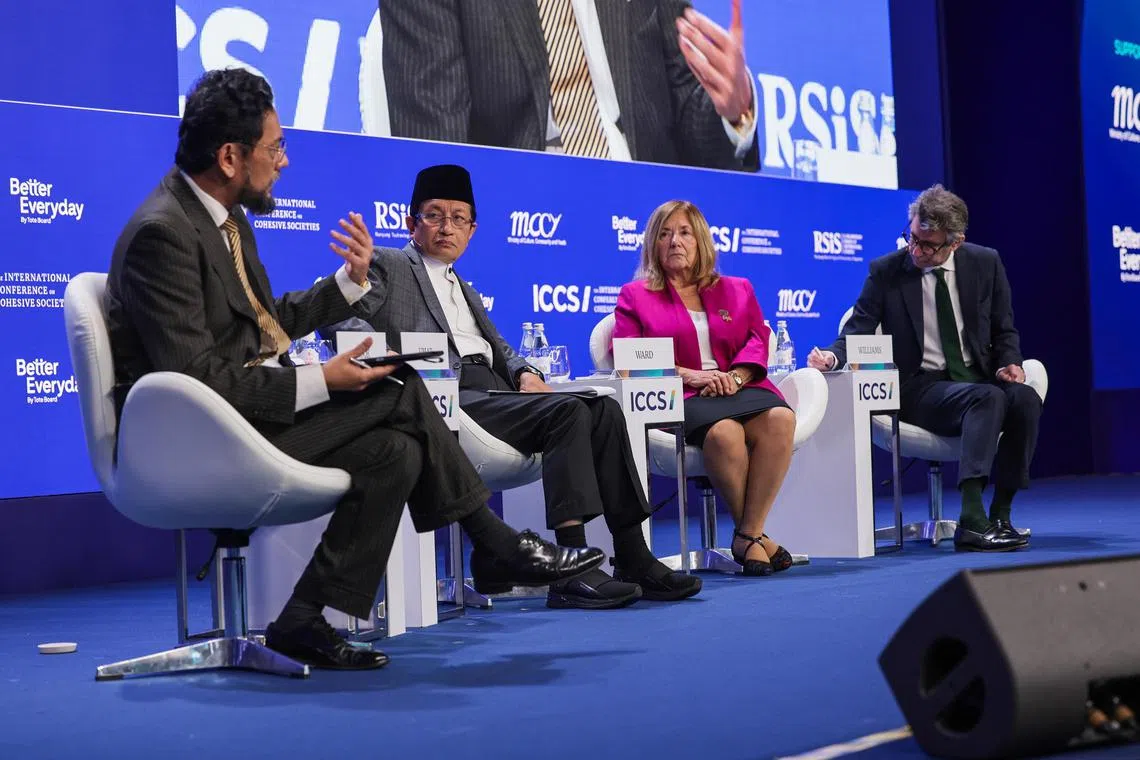
Speaking at the first plenary session of the three-day conference, Professor Colleen Ward from Victoria University of Wellington in New Zealand said her research found that people who engage in multicultural contact tend to have a stronger sense of national belonging.
Meanwhile, minority and immigrant groups who live in countries with multicultural policies report higher trust levels and lower levels of perceived discrimination, added the professor of cross-cultural psychology.
Such strengths, however, rest on a foundation of mutual trust, which is in short supply today, said fellow speaker Mr Ed Williams, president of Edelman International.
He pointed to the results of the annual Edelman Trust Barometer, which since 1999 has been measuring the level of trust people in various countries have in societal institutions.
The latest study, published in January, found that a majority of respondents in 23 of the 26 countries surveyed felt moderate to high levels of grievance against business, government and the rich. Singapore was the country with the least amount of grievance reported, with fewer than 4 in 10 expressing such sentiments.
Mr William said it was worth thinking about why Singapore stood as an outlier compared to the rest of the world, where there was a “collapse of the middle ground (and) the unraveling of shared understanding”.
“Could Singapore’s deliberate approach to managing diversity, its longstanding emphasis on multi-racial harmony and integration, be one of the factors helping to sustain a deeper level of institutional trust?” he asked.
“No doubt there are other contributing factors, but in a global environment increasingly defined by division, there may well be lessons here that others would do well to study.”
Prof Ward said one reason why things are looking bleak for multiculturalism in many places is the number of “existential threats” there are today, such as wars, pandemics, natural disasters and financial crises.
Her research found that countries become more “culturally tight” when faced with such threats, which means there is lower tolerance for deviance from social norms and less openness to differences.
“Essentially, what we find is that ‘tight’ cultures are more prejudiced cultures,” she said, adding that these results were replicated across 25 countries and the 50 states of the United States.
Despite the pessimistic outlook for multiculturalism, the speakers emphasised that people and communities have the agency to make a difference.
Indonesia’s Minister of Religious Affairs Nasaruddin Umar, the third speaker on the panel, noted that faith communities can play a role, including to identify kalimatun sawa, an Arabic phrase that translates to common ground.
For instance, the Istiqlal State Mosque in Jakarta conducts regular interfaith activities, and even has a Tunnel of Friendship that connects it with the nearby Church of Our Lady of the Assumption, said Dr Nasaruddin, who is also Grand Imam of the mosque.
He said that conflicts in the Middle East, such as in Gaza and involving Israel and Iran, also represent a failure of conventional diplomacy and highlights the need for faith-based diplomacy in international relations.
Involving faith leaders in peacemaking efforts would recognise the significance of religion in shaping global affairs and facilitate collaboration across religious divides, he added.
Prof Ward said building multiculturalism should not be seen as the sole responsibility of governments, and that citizens acting together can effect change.
She cited how New Zealanders came out and marched on their parliament in 2004 to protest acts of desecration that targeted Jewish graves in Wellington.
This prompted the Kiwi Government to develop the New Zealand Diversity Action Programme, which aimed to recognise the country’s cultural diversity and to foster harmony among its peoples.
Agreeing, Mr Williams said no one organisation can solve a crisis of this magnitude alone, but only together with other partners.
“This is not a moment for institutional posturing, it’s a moment for collective action – government with business and civil society, and a media sector that champions truthfulness are critical as we move forward,” he said.
Read more on The Straits Times

