







December 28, 2025
By The Habesha News Desk
Photo credit: Marta Pausilli
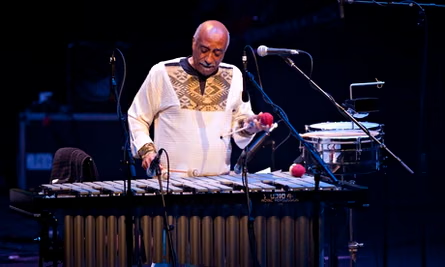
At the age of 82, Mulatu Astatke, widely regarded as the Godfather of Ethio-jazz, has performed what has been announced as his final live concert, bringing to a close a historic performing career that spans more than six decades.
The farewell concert, held in London, was both celebratory and deeply emotional. As reported by BBC News, Astatke raised his arms in gratitude before a warm and attentive audience, marking the end of his live appearances while affirming the enduring power of the musical genre he created. The moment symbolized not just a personal farewell, but the culmination of a lifetime devoted to redefining Ethiopian music on the global stage.
Architect of Ethio-Jazz
Mulatu Astatke is credited with creating Ethio-jazz — a sophisticated fusion of Ethiopian pentatonic scales (qenet), Afro-Latin rhythms, and modern jazz. He has long described Ethio-jazz as a “science,” emphasizing its theoretical depth and cultural lineage rather than viewing it as mere experimentation.
International recognition for Astatke expanded significantly after his music was featured in the 2005 film Broken Flowers, directed by Jim Jarmusch. More recently, renewed global attention followed the inclusion of his work in the Oscar-nominated film Nickel Boys, according to coverage by the BBC and other international media outlets.
The London concert opened with a composition inspired by a 4th-century Ethiopian Orthodox Church melody — an intentional nod to the spiritual and musical roots of his homeland. Wearing a shirt adorned with artwork by renowned Ethiopian painter Afewerk Tekle, Astatke carefully moved past his congas to take position at the vibraphone, his primary instrument. Using three mallets, he produced layered rhythms and resonant melodies that reflected decades of mastery and restraint.
From Jimma to the World
Born in 1943 in Jimma, southwestern Ethiopia, Astatke’s path to global influence was shaped abroad. As documented by BBC News, he attended Lindisfarne College near Wrexham, North Wales, initially studying engineering. His musical talent, particularly on the trumpet, soon redirected his future.
Encouraged by mentors, Astatke enrolled at Trinity College of Music in London, immersing himself in the city’s jazz scene and performing at clubs such as the Metro Club alongside pioneering Jamaican saxophonist Joe Harriott. He later became the first African student at Berklee College of Music in Boston, where he studied vibraphone and percussion while incorporating Latin jazz influences into his evolving sound.
“Swinging Addis” and Staying the Course
Upon returning to Addis Ababa in 1969, Astatke pioneered Ethio-jazz during the vibrant “Swinging Addis” era. His fusion of Western jazz with Ethiopian musical modes initially faced resistance from audiences unfamiliar with the sound. Nevertheless, he persisted, helping redefine Ethiopia’s modern musical identity.
Following the overthrow of Emperor Haile Selassie in 1974, many Ethiopian musicians left the country. Astatke chose to stay, continuing to innovate and draw from traditional Ethiopian instruments such as the washint flute, kebero drums, and the masenqo — a one-stringed fiddle he often compares to the cello. As noted in multiple analyses published by Zehabesha.com, Astatke has consistently argued that traditional Ethiopian musicians are intellectual pioneers, lamenting the lack of formal research and global acknowledgment of Africa’s musical innovations.
An Enduring Legacy
Audience members and fellow musicians described the London concert as “bittersweet,” according to BBC interviews conducted after the performance. Fans across generations reflected on Astatke’s rare ability to connect grandparents, parents, and younger listeners through a shared cultural soundscape.
Coverage by Zehabesha.com has long emphasized Astatke’s role as a cultural bridge — introducing Ethiopian music to international audiences while remaining firmly rooted in Ethiopia’s historical and spiritual traditions. Although he is stepping away from live performance, his influence continues through recordings, film soundtracks, academic study, and the countless artists shaped by his work.
As Mulatu Astatke exits the concert stage, Ethio-jazz remains alive and evolving — a lasting testament to a musician whose life’s work transformed Ethiopian culture into a global language of sound.
Read more on EthioPoint: The Habesha Latest Ethiopian News and Point of View 24/7

