






MegaETH public mainnet is soon, but what is MegaETH, and how does it work?
Welcome to Little Learnings, a series of educational posts I release every Friday. The intention behind these is to break down some new interesting topic or development happening in the crypto space. God knows there’s enough happening in crypto, and it’s often complicated — so I’m here to try and simplify it a bit.
A fitting sponsor for this free newsletter, Open Campus is building the onchain financial layer for education.
They recently announced a partnership with the Government of Madhya Pradesh (a state in India) to bring 50 MILLION academic records onchain.
Every graduate in the state will have a verified digital credential on EDU Chain.
This is a pretty incredible achievement and will push forward the future of the role of blockchain technology in education.
Learn more here (check it out, it’s genuinely a very cool partnership).
Disclaimer: I invested in the Sonar round for MegaETH.
I’ve written about MegaETH before, but haven’t really broken down how it works. That’s what today is for. The timing feels appropriate, as they just announced that their Public Mainnet is going live on the 9th of Feb.
Starting from the basics, what is MegaETH? It is an Ethereum Layer 2 designed for real-time performance. Not the “fast” performance you see on Base or Solana where you submit a transaction and it’s approved in like half a second. Real time means real time, and the only way to do that is by being able to process tens of thousands of transactions per second.
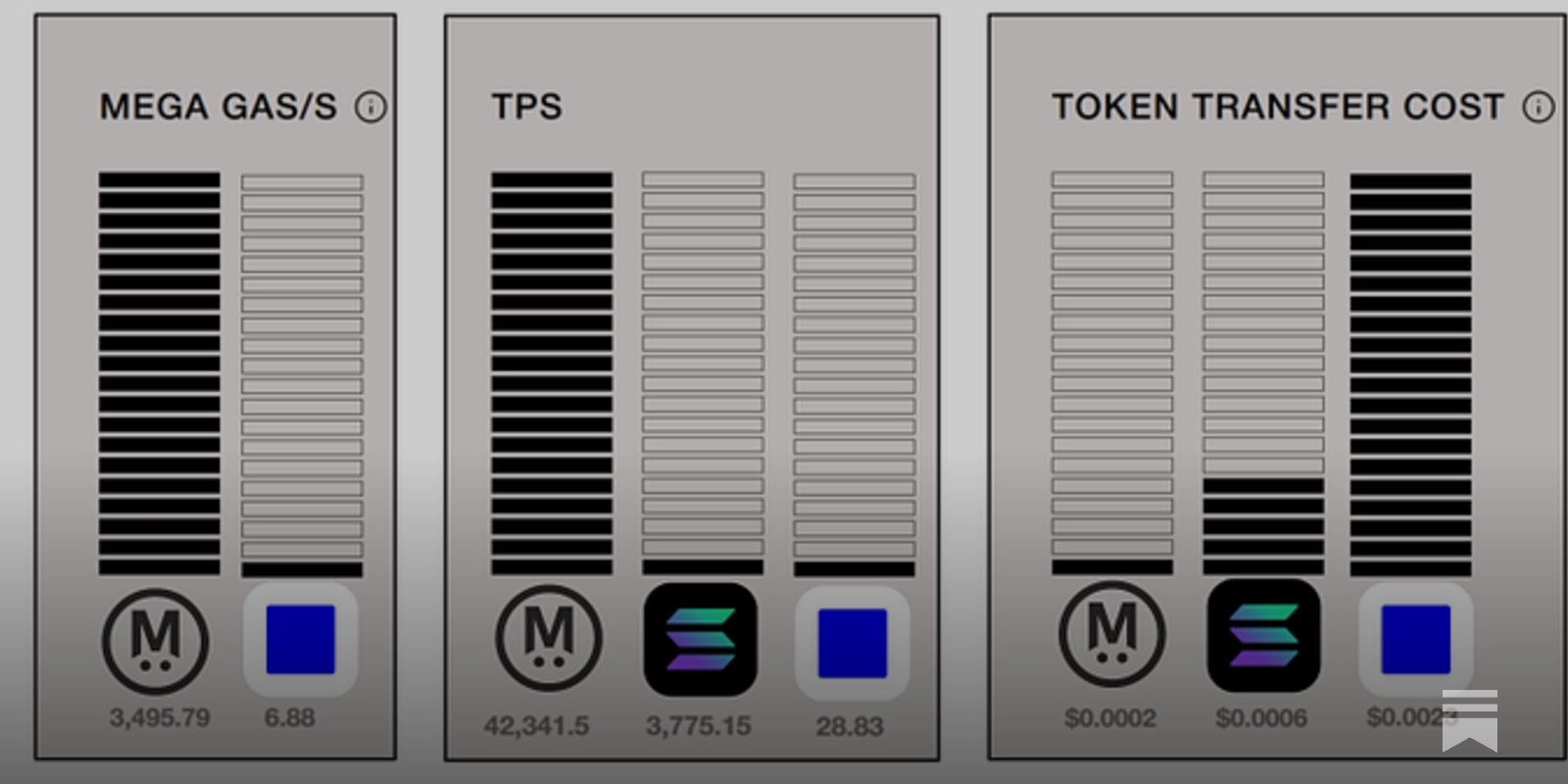
Base is sitting at ~28 TPS, Solana at ~3,700, and MegaETH at ~42,000! 🤯
Their target is 100,000 transactions per second with sub-millisecond latency. To get there, the team rebuilt how blockchain nodes operate from the ground up. Below is my understanding of how it works.
It’s a bit technical, and I might have got something wrong (or more likely, might have painted an incomplete picture). I chose to make it as simple as possible to understand; my apologies if anything important is overlooked, please let me know in the comments and I will amend the article if that’s the case!
Traditional blockchains force every node to do everything: consensus, execution, validation, storage. This redundancy is what kills throughput. The slowest node in the network becomes the bottleneck for everyone.
MegaETH takes a different approach. It splits responsibilities across specialized node types, each optimized for a specific task.
The system runs on four node types:
This separation means the sequencer can push maximum performance without waiting for slower nodes to catch up.
How it works in practice: a user submits a transaction through an RPC node. The sequencer receives it, executes it, and includes it in a block. The sequencer then broadcasts execution results (receipts, state changes) to replica and full nodes. It also submits blocks to EigenDA for data availability and to Ethereum mainnet for finality.
Because there is only one sequencer during normal operation, there is no consensus overhead. This means there’s no waiting for agreement between nodes and transactions can process immediately.
As with other L2s, MegaETH remains fully compatible with the Ethereum Virtual Machine. This is honestly one of the best things about L2s, as devs can deploy existing smart contracts without any real modification if they want, and they’ll just work.
Those familiar with the Blockchain Trilemma will know that there are always tradeoffs. To achieve such insane scale, you’re gonna sacrifice something else, at least to begin with.
Having a single sequencer will naturally introduce centralization risk. If you want to read more about this risk and some of the others, I recommend this X post and then this subsequent response which addresses the concerns.
The TLDR is that there are real centralization concerns at this point. These apply to all L2s, and it is on them to progress to a robust stage. It is on the community to hold them accountable.
One of the coolest things about MegaETH, to me, is that real-time performance unlocks applications and use cases impossible on other infrastructure: onchain games, extremely high-frequency trading, AI agents transacting autonomously and instantly. Of course these things are possible on other chains, but MegaETH takes it to the next level.
Whether it ultimately pays off and works will depend on what developers build, and whether users end up using the chain. I’m generally pretty bearish on new blockchains. I don’t think we really need more L2s or L1s. MegaETH is an exception in my mind, and I am (cautiously) optimistic that it will succeed where so many others have failed.
Thanks for reading, see you next week with another little learning!

