






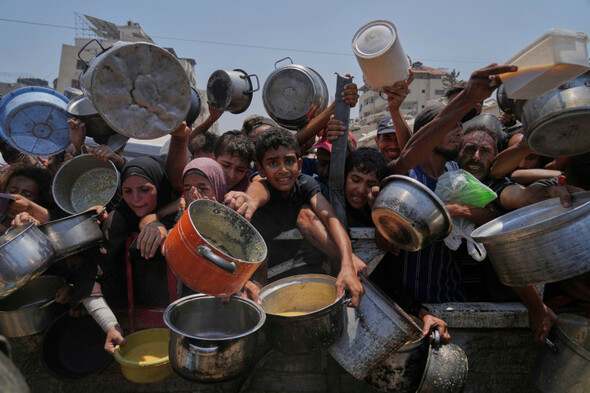
The UN estimates that Israeli forces have killed over 1,000 people attempting to access food in Gaza.
THE ISRAELI MILITARY has announced a “tactical pause” in operations in certain areas of Gaza to facilitate humanitarian aid.
According to a statement shared on Telegram, the pause will take place daily until further notice in areas where the Israeli Defence Forces (IDF) are not currently active: Al-Mawasi, Deir al-Balah, and Gaza City. Secure routes will be designated to allow safe passage for humanitarian convoys.
The IDF stated it would continue to support humanitarian efforts while maintaining “ongoing manoeuvring and offensive operations against terrorist organisations in the Gaza Strip to protect Israeli civilians”.
It also said it was prepared to expand the scale of the pause if necessary.
The announcement comes amid escalating concern over the worsening humanitarian situation in Gaza.
On Friday, Palestinian health officials reported five more deaths due to malnutrition, bringing the total to 127, two-thirds of whom were children.
Among the latest deaths was a five-month-old girl who weighed less than at birth. A doctor at Nasser Hospital described it as a case of “severe, severe starvation”.
Advertisement
Medical staff have also been affected, with some resorting to IV drips to continue treating patients.
Médecins Sans Frontières (MSF) warned on Friday that 25% of young children and pregnant women in Gaza are now malnourished, calling the lack of food and water “unconscionable”.
The UN estimates that Israeli forces have killed over 1,000 people attempting to access food, the majority near militarised aid distribution points under the US-backed Gaza Humanitarian Foundation.
Philippe Lazzarini, head of UNRWA, described the hunger crisis as “manmade” and criticised aid air drops as expensive and inefficient. “Lift the siege, open the gates, and guarantee safe movement and dignified access to those in need,” he urged.
Lazzarini added that 6,000 trucks loaded with aid are waiting in Jordan and Egypt for permission to enter Gaza.
In response to mounting pressure, the IDF said it had carried out a humanitarian airdrop containing “seven pallets of aid including flour, sugar and canned food”, coordinated with international organisations.
Israel has faced increasing international criticism over the deepening crisis, after imposing a total blockade on Gaza on 2 March. Though a limited flow of aid resumed in late May, aid agencies warn it falls far short of what is needed to curb rising malnutrition.
Despite this, the IDF maintains that there is “no starvation” in Gaza.
Additional reporting from AFP
Readers like you are keeping these stories free for everyone… A mix of advertising and supporting contributions helps keep paywalls away from valuable information like this article. Over 5,000 readers like you have already stepped up and support us with a monthly payment or a once-off donation. Learn More Support The Journal

