






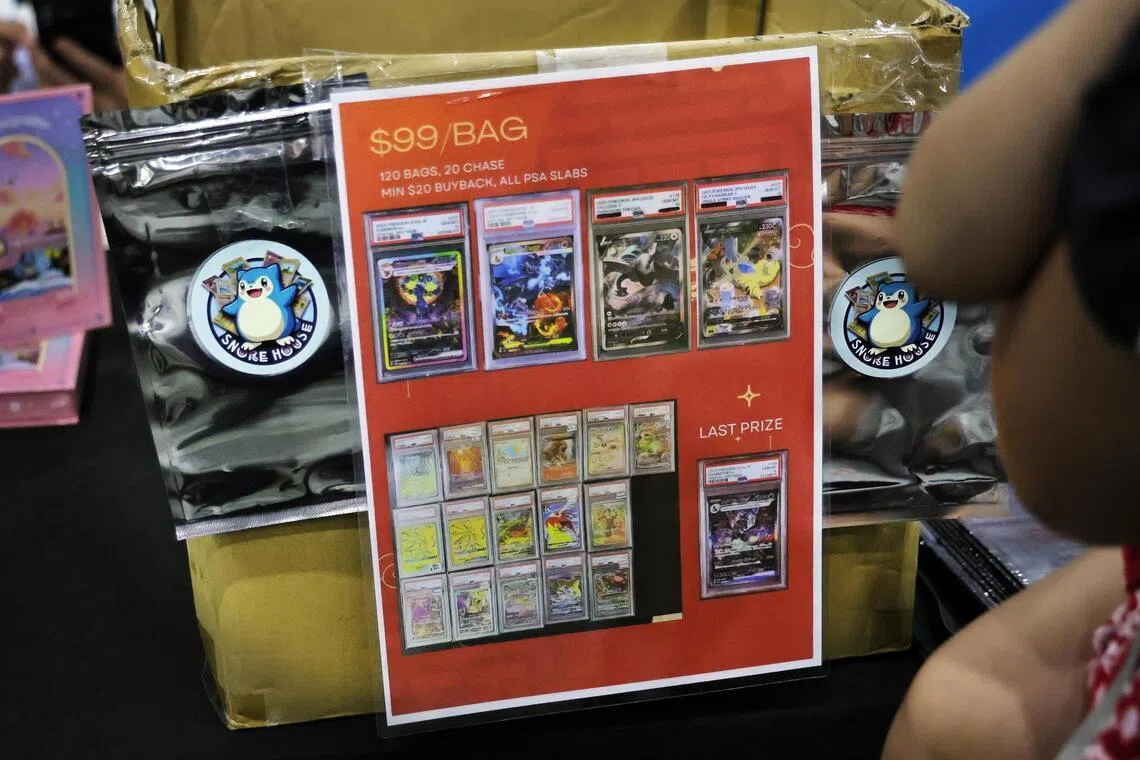
SINGAPORE – Priced from a few dollars to over $100 per pack, these products promise buyers
a shot at rare, valuable trading cards
they claim are worth thousands.
Known as “Oripas” (original packs), they are not official products but are seller-made blind packs marketed as a low-cost chance at high-value cards.
Sellers repack cards of varying values into mystery packs sold at a premium, with claims of high-value chances that are difficult to verify.
Ultimately, buyers often end up with cards worth far less than what they paid for.
Hobbyists said Oripas should be banned due to the gambling and scam risks they pose.
The Ministry of Home Affairs (MHA) has said
trading card packs will be regulated
to manage gambling risks involving blind boxes, with
details
expected
around mid-2026
.
Enthusiasts said because of pre-orders and Oripas, the industry is now plagued by scams.
At Kyo Cards Con, a trading card convention held at the Singapore Expo over the weekend, The Straits Times observed over a dozen vendors selling Oripas.
One of them was Mr Yong, a student, who was running a booth that sold such packs for $128.
He said he packed them himself, with buyers guaranteed to get a card that would be worth at least $50, and a chance to get cards worth more than what they paid for.
He said: “No one is forced to buy them. Oripas are not gambling, because you are paying for something in return. Gambling is only when you have a chance of getting nothing back, like at a casino.”
Others disagreed.
Mr Patrick Keane, 30, co-founder of Vault Cards TCG, said Oripas are a form of glorified gambling, and in some cases, outright scams.
He said sellers have shown a card worth around $10,000 on their Oripas packaging, but after buyers bought all the packs, none contained the card.
He said: “A lot of it is misleading and unethical. Previously, many sellers promoted their Oripas on TikTok, but the platform has since banned them.”
Student, Mr Randy Leong, 25, has a trading collection worth about $10,000. He buys Oripas overseas, and often ends up with cards worth less than what he paid for.
He said: “It is the chance of valuable cards that lures many to buy Oripas. Especially if it’s a very expensive card advertised as one of the prizes.”
Home Affairs Minister K. Shanmugam said on Feb 12 the Gambling Regulatory Authority (GRA) and MHA were
drafting regulations
for blind boxes.
He was responding to a question from Mr Dennis Tan (Hougang) about whether the Government intended to legislate mandatory and standardised disclosure of odds and probability ranges for blind-box or “gacha” products.
Speaking to ST, Mr Tan said a resident was concerned young people were being scammed by livestream sellers.
Livestream commerce has
grown rapidly across social media platforms
, facilitating the sale of goods ranging from fashion and food to trading cards, which have emerged as a leading category.
The record-breaking prices of some trading cards have fuelled the popularity of such livestreams.
In February, American social media influencer Logan Paul
sold a rare Pokemon card at auction for over $20 million
.
A local collector featured by ST
rejected
a $1.3m offer
for one of his cards.
Mr Tan said a core problem was how some sellers preyed on consumers by removing rarer items before selling them to consumers.
He said: “Stronger consumer protection is needed for those buying blind boxes, gacha products and trading cards, especially where many buyers are minors, which raises questions about informed consent, impulse spending, and platform safeguards.”
He added Singapore should learn from Japan and China where the exact odds for every rarity type are listed clearly on the packaging.
Teacher, Mr Zack Zhang, 36, who has a trading cards collection worth about $30,000, welcomed the impending regulations and hopes the authorities clamp down on Oripas.
He said: “It’s due time. For us hobbyists, I don’t think we are doing anything wrong so we shouldn’t be afraid of regulation.”
On Oripas, clinical psychologist Carol Balhetchet said: “We are cultivating young people to become scammers. They will think, oh I have some cards I don’t want, I can do that and sell for lots of money. There are enough scammers as it is.”
She added while trading card communities can be good for the social development of the young, the gambling element of trading card packs must be managed.
She said: “They are a form of gambling. You chase that dopamine high of getting a special card, developing compulsive behaviour.”
Others are concerned about how regulations might impact the community.
Mr Jonathan Lee, 34, co-founder of Deckard Gaming, said he is uncertain how his company, which hosts Pokemon trading card game events, will be affected.
Such events involve players using card decks to battle one another, with winners receiving exclusive promotional cards.
He said: “With regulations in place, I’m concerned about the picture they might paint about trading cards. Many of us started off by playing as kids, viewing the game through relatively innocent lens. Regulating trading card packs could change that perception.”
Mr Ronald Chiam, 34, who works in the finance industry and has a Pokemon card collection worth around $200,000, wondered how card prices and access to them might change.
He said prices have tripled in the last five years, blurring the line between collector and “investor”.
He said: “It’s become difficult to disassociate the hobby from money and taking the fun out of it.
“Now, when I flip my binder of cards, instead of enjoying my collection, I think about how much each one is worth.”
Read more on The Straits Times

