






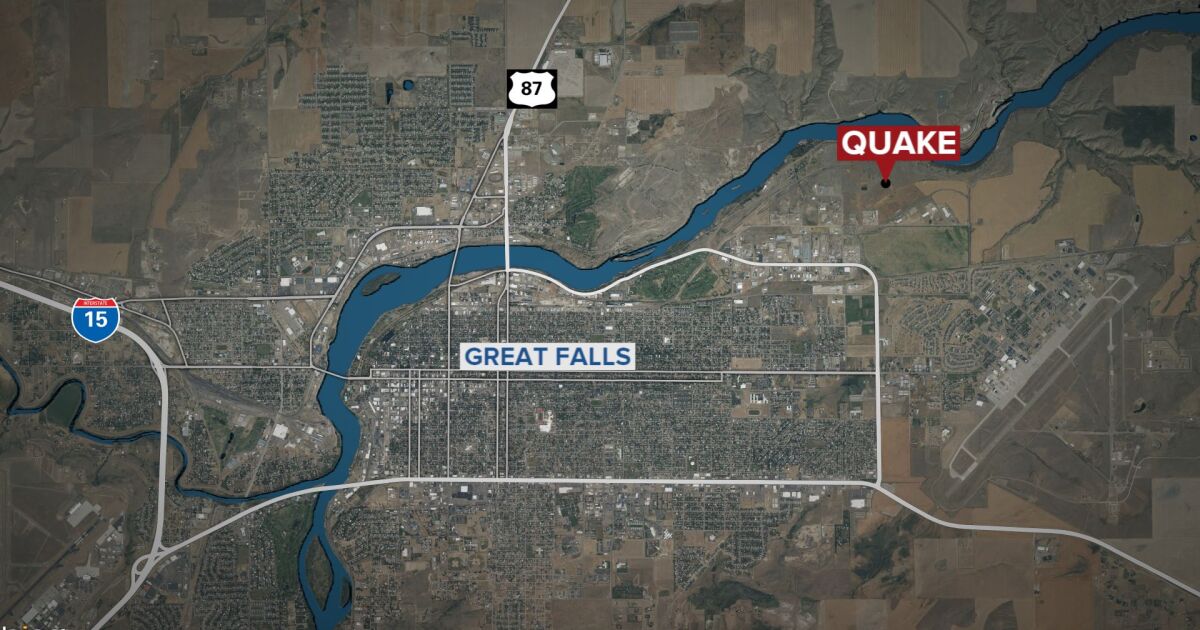
Several people reported feeling what they believed to be a small earthquake on Saturday, January 31, 2026 – and the USGS confirmed the quake was a magnitude 3.2.
It occurred at 6:22 p.m., and was centered about 1.8 miles northwest of Malmstrom Air Force Base and at a depth of six miles.
We started receiving reports at around 6:23 pm, and among the messages we received were:
I felt the rumble and so did my neighbor. 2 blocks from Montana Credit Union Possible aftershock happened at 6:23pm A friend also said they felt it in the river view My parents said they felt it after the shock??? 6:27 pm?? Are we getting another aftershock now? Another earthquake now. Not as strong as the previous one. I heard a bang about 7 minutes ago, and another one after the shock?
There have been no reports yet of injuries or damage.
We will update you if we get more information.
This comes just two days after a 4.2-magnitude earthquake shook the area, with its epicenter about 4.9 miles northeast of Great Falls.
Seismologists said small aftershocks are possible in the days following the initial quake, which is what likely happened on Saturday.
On Thursday, KRTV interviewed Cascade County Sheriff Jesse Slaughter (for an unrelated story) when the earthquake hit – watch the video:
Residents’ reaction when the earthquake shook Great Falls
The Treasure State is located in one of the most seismically active areas in the United States. The Intermontane Seismic Belt, which runs through the western third of the state, is where most of Montana’s seismic activity occurs. The vast majority of the numerous earthquakes throughout the region are very small, rarely felt by people, and do not cause any damage. There’s a team of experts at the Yellowstone Volcano Observatory who track them all; Click here to visit the site.
There is also an office of seismic studies on the campus of Montana Tech in Butte. It manages the Montana Regional Seismic Network, a network of 42 permanent seismic stations located throughout western Montana. “Although it has been more than four decades since the last devastating earthquake in Montana, small earthquakes are common in the region, occurring at an average rate of 7-10 earthquakes per day,” the site notes.
The site contains several interactive maps, including one showing the 2,395 earthquakes recorded in Montana during 2018 and additional earthquakes in the surrounding area. All but 23 of those earthquakes registered below 3.0, showing how small and imperceptible the vast majority of them are.
There have been some notable earthquakes in Montana’s history, including the 7.3 magnitude Hebgen Lake earthquake on August 17, 1959. The earthquake triggered more than 160 new geysers throughout Yellowstone National Park. There were also about 28 deaths due to the rockslide in Madison Canyon.
On July 6, 2017, one of the strongest earthquakes to hit Montana in decades shook the community of Lincoln northwest of Helena. Its center was 5.5 miles southeast of Lincoln and at a depth of about 2.6 miles. People reported feeling the 5.8-magnitude quake across Montana and the Northwest, with some reports coming in from as far away as Vancouver and Lethbridge, Canada. It caused some minor damage, but no serious injuries.
In January 2026, a 4.2 magnitude earthquake occurred several miles northeast of Great Falls. No injuries or serious damage were reported – click here for more details.
The earthquake occurred at 12:41 p.m., and was centered about 4.9 miles northeast of Great Falls and at a depth of about 13.6 miles.
MTN News was interviewing Cascade County Sheriff Jesse Slaughter (for an unrelated story) when the earthquake struck – watch the video:
Residents’ reaction when the earthquake shook Great Falls
The plains of central and eastern Montana are less prone to earthquakes, but few significant earthquakes have been reported.
According to the USGS, a 5.3 magnitude earthquake struck northeastern Montana on May 15, 1909.
Several smaller earthquakes have been recorded in Roosevelt County, including an estimated 4.5 magnitude earthquake in the town of Freud that resulted in some damage to a grain bin in 1943.
Although it has been some time since the state has seen a devastating earthquake, small earthquakes occur several times every day. Click here to learn more about earthquake preparedness.
What Are The Main Benefits Of Comparing Car Insurance Quotes Online

